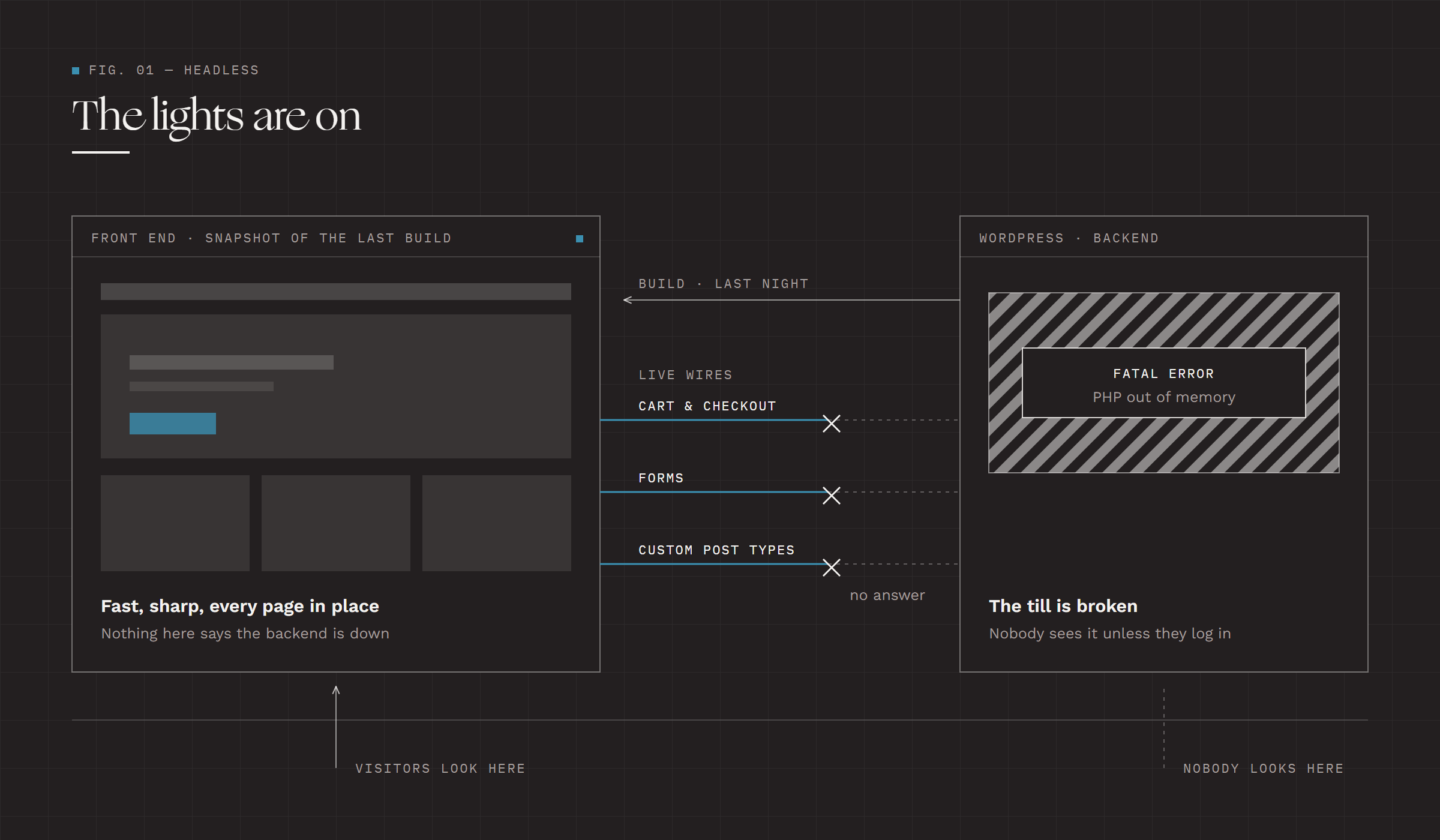
This morning I opened the admin of one of my headless sites and got a white page with one line on it: a fatal error, PHP out of memory. The backend was down.
Then I opened the site itself. It looked perfect. Fast, sharp, every page in place. Nothing on it suggested that the system behind it had just fallen over.
The fix took five minutes. What stayed with me was the other question: if I had not happened to log in, how long would it have taken me to find out?
The alarm you didn’t know you had
A classic WordPress site is its own alarm. The part visitors see and the part you manage are one body, so when something breaks, it breaks in public. A plugin conflict or a memory limit puts “There has been a critical error on this website” where your homepage used to be.
That is embarrassing, and it is also useful. You find out within minutes, because a customer, a colleague or your own eyes tell you. Nobody set that alarm up. It came free with the architecture, which is why almost nobody notices it is there.
What headless quietly takes away
Going headless removes that alarm without telling you. The front end is no longer the system. It is a snapshot of the system, taken at the last build, plus a few live wires that reach back when they need something: the cart and checkout, a form, a page that pulls fresh data from a custom post type.
The snapshot cannot break when the backend does. That is the selling point, and it is real: my site stayed up this morning while WordPress was down. But the same resilience hides the outage. Only the live wires can show a failure, and they sit on the pages you visit least and your customers need most.
My own site is a good example. A small but important part of it runs on custom post types built with Meta Box. None of that content appears on the homepage. I could have looked at the homepage every day for a week and seen nothing wrong, while the pages that depend on those post types had nothing behind them.
Think of a shop whose window stays beautifully lit while the till inside is broken. From the street, everything is fine. You only learn otherwise when someone tries to pay.
So the misleading part is not that headless breaks more often. It breaks quietly, and it breaks out of your sight.
Changing how you think
None of this is an argument against headless. It is an argument for dropping three habits that classic WordPress taught us.
“It looks fine” is no longer evidence
On a classic site, loading the homepage is a health check. On a headless site, it proves only that the snapshot is being served. The useful question changes from “is the site up?” to “when did I last see proof that the wires are live?”
The alarm has to be rebuilt on purpose
What used to come free now has to be built. Something has to walk the dynamic paths for you, regularly, and tell you when one fails:
- a check that opens a page fed by live data and confirms real content came back
- a check that the cart or checkout still answers
- a warning when a shop that normally sells every day has gone unusually long without an order
The tools matter less than the principle. Silence should mean “checked and fine”, not “nobody looked”.
Failure should be loud
The instinct when building is to fail gracefully: if the data does not arrive, show an empty list, a placeholder, last week’s content. It feels professional. It is also exactly how a broken connection ships as a good-looking page with nothing on it.
I now prefer the opposite. A build that stops, or an error I can see, beats a page that politely hides the problem. Graceful is for the visitor. For the owner, a failure should be impossible to miss.
The backend is still a place
Headless tempts you to treat WordPress as plumbing: installed once, never opened again. But everything that could go wrong there before can still go wrong. Updates, plugin conflicts and memory limits did not leave when the front end did. You just stopped walking past them every day.
And the backend changes without you. Plugins update themselves. WordPress updates itself. Any of those can break something overnight, with nobody having touched the site. You can switch automatic updates off, of course, but that creates another set of challenges: now every security patch waits for you to remember it.
So I visit. Not to do anything in particular, only to see that the admin loads and nothing is complaining. This morning that habit, or luck, is what caught the problem.
A habit is not a solution, though, and I do not have one yet. I am going to start digging for a proper way to know when the wires go quiet, and I will write up what I find.
Headless gave me a front end that does not fall over when the backend does. I had not noticed that it also took away the thing that used to tell me. The site will keep its lights on either way. Checking the till is now my job.